
Ponytail Thinning Coverage: Hiding the Gaps a Pulled-Back Style Reveals
There’s a particular moment most of us know well. You pull your hair back, turn your head, and the overhead light finds something the mirror never shows you when your hair is down. A pale stripe at the part. Two thin spots at the temples. A hairline that looks further back than it did last year. That’s the problem ponytail thinning coverage solves — not by changing your hair, but by taking the glare out of the scalp underneath it.
Because here’s what’s actually happening: a ponytail doesn’t cause the thinness you’re seeing. It reveals it.
Why a pulled-back style exposes so much
When your hair is loose, it falls in overlapping layers. Every strand casts a small shadow over the scalp beneath, and those shadows do a surprising amount of camouflage work for free.
Pull everything back and you strip that away. The hair is smoothed into a single direction, tension flattens it against the head, and the scalp goes from mostly hidden to fully lit — especially along the part, at the temples, and in the sparse halo just behind the hairline. Nothing has changed about how much hair you have. The lighting conditions just got a lot less forgiving.
This is also why the same ponytail can look fine in your bathroom and alarming in a car mirror at noon. Bright, direct, overhead light is the enemy of a pale scalp.
Where to look before you start
Put the style in first, then assess. Trying to cover a thin area before you’ve pulled it tight is guesswork, because tension moves everything.
Once the ponytail or bun is in, check four places in daylight with a hand mirror:
- The part line — usually the widest-looking area, because tension pulls hair away from it on both sides.
- The temples — where fine baby hairs used to soften the edge and may not anymore.
- The front hairline — the shallow inch where a smoothed-back style reads as “receding” even when it isn’t.
- The seam around the elastic — where hair splits and a stripe of skin shows through.
You now know exactly where to press powder, and you’ll use half as much as you would guessing blind.
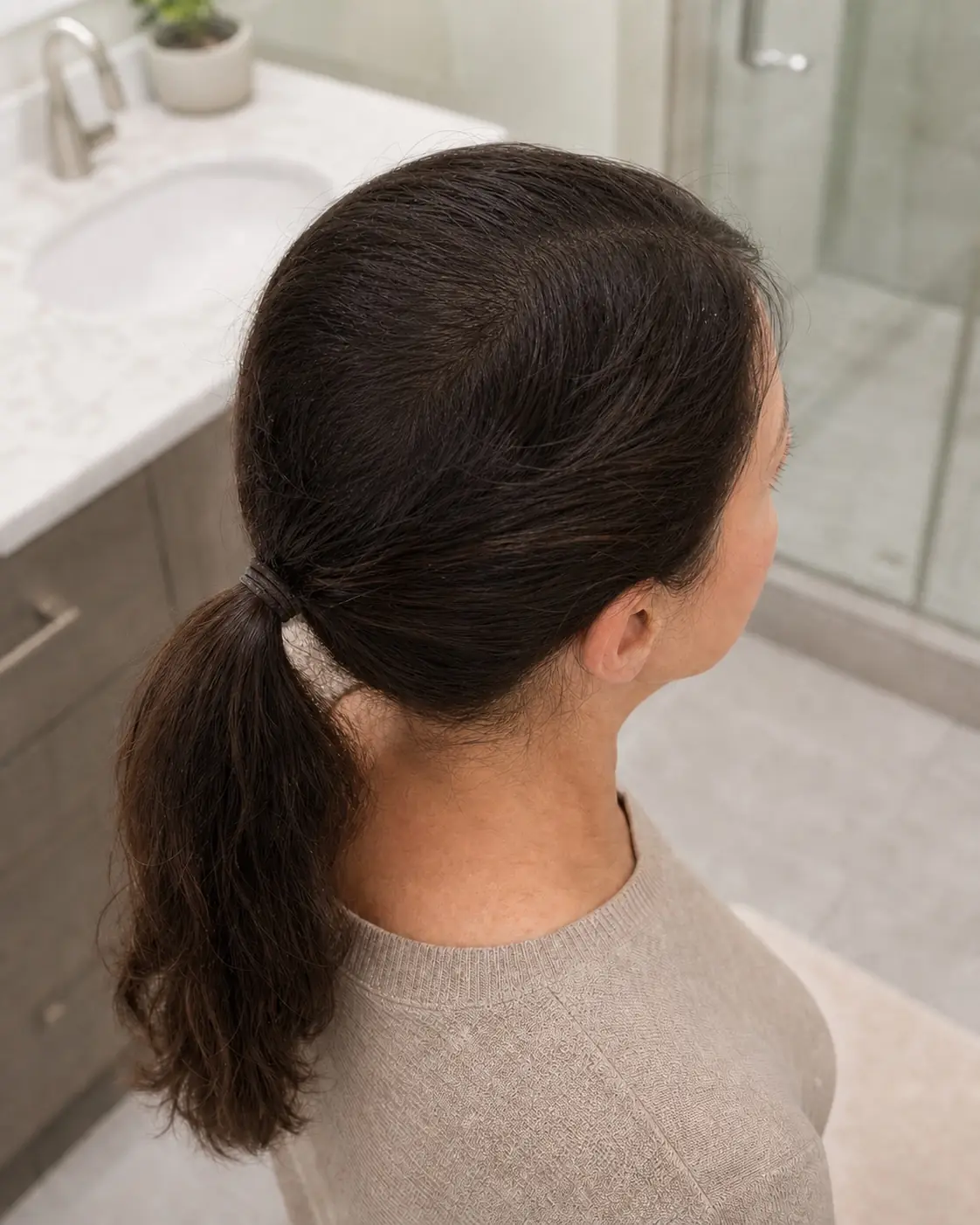
How to apply ponytail thinning coverage in under two minutes
1. Style first, cover second. Finish the ponytail, bun, or updo completely. Hairspray last, not first.
2. Tap, don’t scoop. Press the slim foam applicator into the powder and tap off the excess against the rim. Too much product at once is the only way this goes wrong.
3. Press, never sweep. Set the applicator flat on the exposed area and press straight down, then lift. Pressing deposits fiber onto the scalp and the hair around it. Sweeping just pushes it around and can disturb a smooth style.
4. Work the part first, edges last. Start at the widest line of scalp and move outward to the temples and hairline, using less as you go. Edges need a whisper.
5. Smooth with a fingertip and check in daylight. Lightly blend the boundary so there’s no hard edge, then look at it near a window. Add more only if you still see skin.
(Before/after and application imagery on this page are AI-generated demonstrations of cosmetic coverage. Thicken It covers the appearance of visible scalp and thinning hair; it does not treat, prevent, or regrow hair.)
Updos, braids and event hair
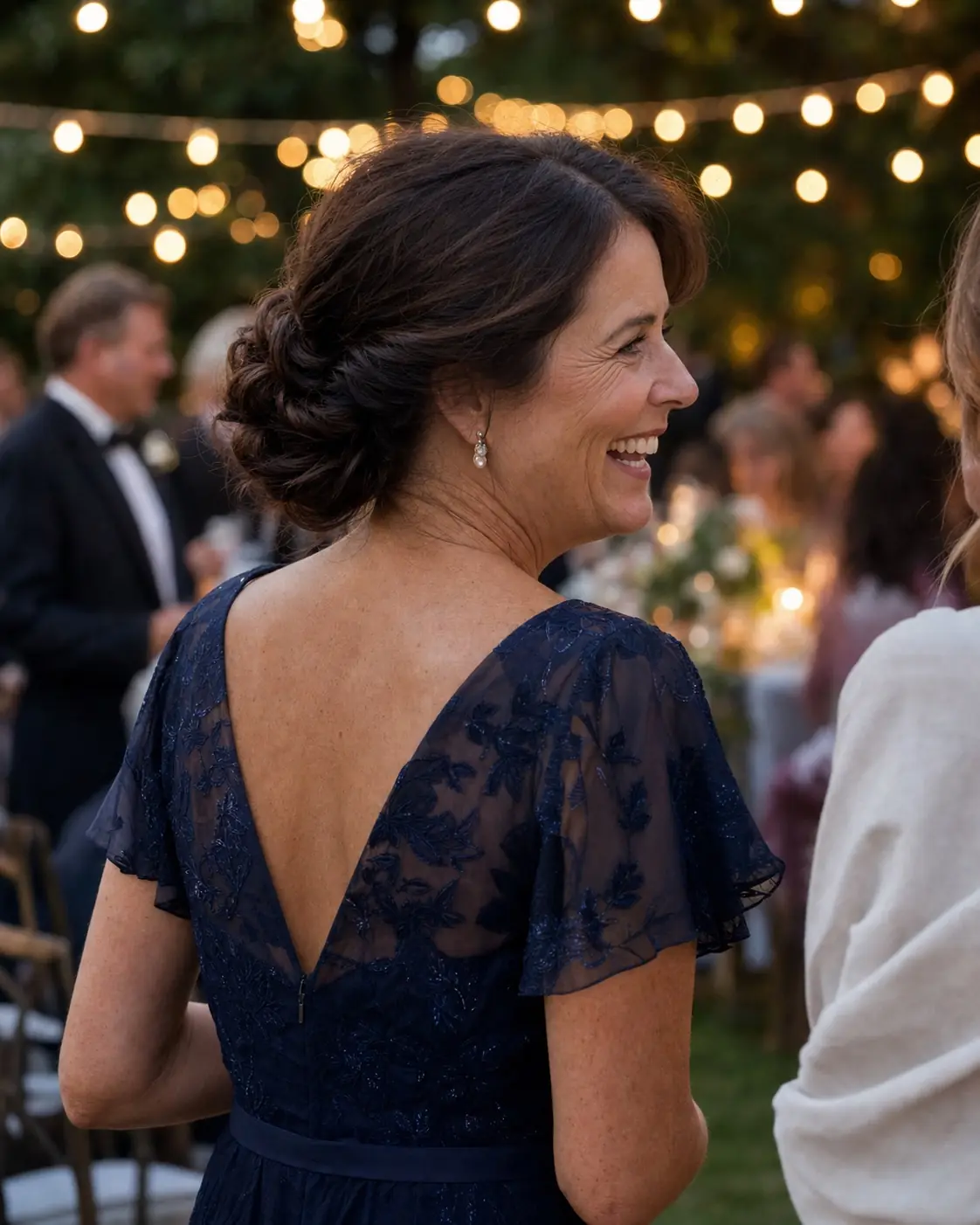
An updo asks more of you than a ponytail, because it exposes more scalp from more angles — and because someone is usually standing behind you taking a photograph.
The method is the same, with two additions. First, have someone check the back, or use two mirrors; the crown is the area you cannot self-assess and the area flash photography loves. Second, cover before any final hairspray, then set. Powder pressed in and then lightly sealed stays put through a long evening of hugs, dancing and warm rooms.
For braids and twists, press along the exposed scalp between sections rather than on the braid itself. You’re darkening the channels of skin that read as gaps, and a light hand along each one does more than a heavy hand anywhere.
A word about how tightly you pull
While we’re here, it’s worth saying plainly: a cosmetic powder covers appearance, and that’s all it does. It has no effect on your hair’s growth or health in either direction.
But the style itself might. The American Academy of Dermatology notes that hairstyles that pull the hair tightly — tight ponytails, buns, braids and extensions — can lead to a type of hair loss called traction alopecia, and that it can become permanent if the pulling continues for years. If you’re noticing thinning specifically at the hairline or temples where your style pulls hardest, or tenderness after taking it down, that’s worth a conversation with a board-certified dermatologist rather than a conversation with a powder compact.
Loosening the style, varying where you place the elastic, and giving your hair pull-free days cost nothing. Cover the appearance today, and take care of the hair for the long run — the two aren’t in competition.
Frequently asked questions
Will it come off on my clothes or pillow?
Pressed in properly and smoothed, it stays where you put it. It’s water resistant — not waterproof — so it holds through sweat, humidity and light rain, and it comes out with shampoo and a good lather.
What if I touch the ponytail during the day?
Blot rather than rub if you need to adjust something. Friction is the one thing that lifts powder, and a five-second re-press fixes it. This is exactly why a compact lives in a purse.
Which shade should I use for a pulled-back style?
Match the hair around the thin area, not your ends. Thicken It comes in Dark Brown, Black, Light Brown and Red — and if you’re between two, take the darker one and apply lightly.
Does it work on gray?
Yes, cosmetically. It covers the brightness of both gray hair and the scalp showing through it, and it shampoos out completely, so it never interferes with a color appointment.
Wear it up, confidently
A ponytail shouldn’t cost you a decision. Two minutes with a compact, a gentler elastic, and you can wear your hair up because you like it up — not because you’ve decided the light is forgiving enough today.
Ready to try it? Shop Thicken It 100% Scalp Coverage Powder →
Related reading: How to Match Scalp Powder Shade to Your Hair · Widening Part Line? How to Make It Disappear in Seconds · Thinning Crown in Women: Why It Happens and How to Cover It Instantly · The Purse Touch-Up Kit That Goes Everywhere You Do