
Receding Hairline Coverage for Men: How to Do It Without Fibers or Sprays
Most men notice it in a photo before they notice it in the mirror. Someone stands slightly above you, the flash goes off, and there it is — the temples pulled back a little further than you remembered, more forehead than you’d have guessed. Receding hairline coverage is one of the most-searched cosmetic fixes there is, and it’s also one of the easiest to get wrong. Done badly, it reads as a hard black line drawn across the forehead. Done well, nobody sees anything at all except a guy whose hair looks like it did a couple of years ago.
The difference isn’t the product category. It’s the technique — and picking a product that behaves the way real hair does at the edge.
Why the hairline is the hardest place to cover
Every other thinning area gives you cover. A crown sits under a canopy of hair. A part line has thickness on both sides of it. The hairline has neither. It’s the border between skin and hair, in full view, in the brightest light on your face.
Two things make it unforgiving. First, the transition matters more than the fill. Real hairlines aren’t a solid edge — they’re irregular, with wispy baby hairs and small gaps that soften where hair stops and forehead starts. Anything that produces a clean, even line looks fake instantly, no matter how well the color matches.
Second, it’s the area most exposed to sweat, hats, and your own hands. Whatever you use has to stay put through a workday, a gym session, and the reflexive habit of pushing your hair back.
Male pattern baldness — androgenetic alopecia — is the reason behind the majority of receding hairlines, and the American Academy of Dermatology notes it typically starts at the temples and works back in a predictable pattern. That’s a condition worth understanding, and a dermatologist is who to see if you want to talk about the hair itself. What follows is purely about appearance: making the scalp show less right now.
Why fibers and sprays struggle at the edge
The three common approaches to hairline coverage each behave differently, and the hairline is where those differences show up hardest.
Keratin fibers are tiny hair-like strands that cling to existing hair with static. They work well where you have hair to cling to — a thinning crown, a widening part. At a receding hairline, there’s progressively less hair to hold them, so fibers tend to drift onto skin, sit on the forehead, and transfer onto pillowcases and collars. Wind and sweat are their weak points.
Colored sprays lay down pigment on both hair and scalp at once. The problem is control. An aerosol pattern is wide and soft-edged, which sounds ideal until you try to build coverage in a two-inch strip without dusting your forehead and eyebrows. Sprays also tend to look flat and matte up close — that painted-on quality that reads as “product” rather than hair.
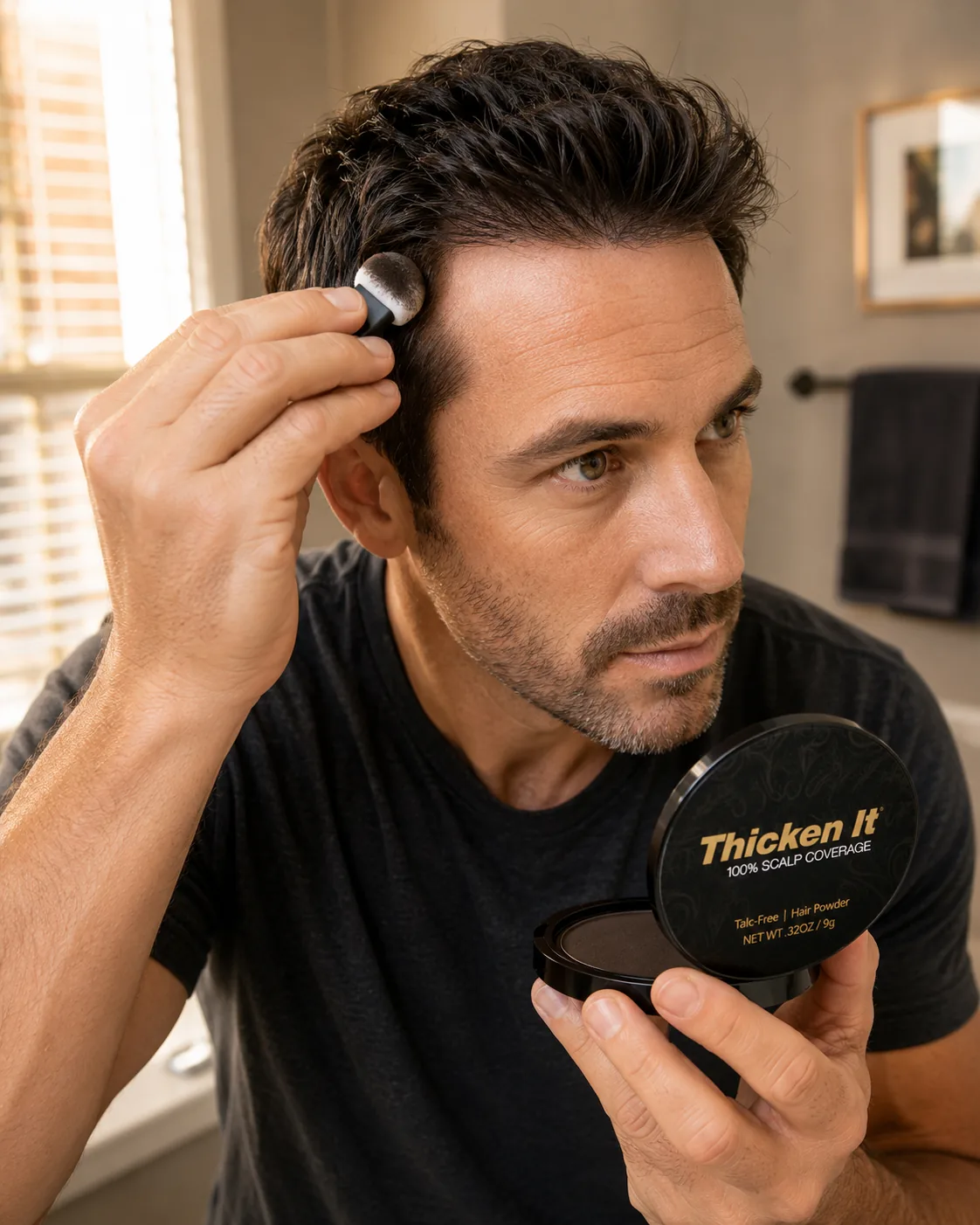
Pressed scalp coverage powder is applied with a small applicator, which means you control exactly where the color goes and how much of it lands. You press it into the scalp between the hairs rather than laying it on top of them, so the skin stops showing through while the hair itself keeps its own texture and light. At an edge, that control is everything.
The technique that makes receding hairline coverage invisible
Here’s the sequence that separates a natural result from an obvious one. It takes under two minutes.
- Start with dry hair and skin. Powder grips on dry surfaces. If you’ve just showered or worked out, blot the hairline first.
- Load the applicator lightly. Tap it into the powder and knock off the excess. You’re building coverage in thin layers, not applying it in one pass.
- Press, never sweep. Tap the applicator straight down into the scalp along the thinning area, working in small steps. Sweeping drags color onto the skin surface and creates a streak.
- Work from back to front. Start where your hair is densest and move toward the hairline. Coverage should get lighter as you approach the edge, not heavier.
- Stop short of the edge, then feather. This is the step almost everyone skips. Don’t take solid coverage all the way to where you want the hairline to be. End it a few millimeters back and use a nearly-empty applicator or a fingertip to tap a few softer, broken marks forward. Irregular beats straight — every time.
- Check it in daylight. Bathroom lighting hides everything. Look at your hairline near a window, straight on and at a slight downward angle, before you leave.
If you’re covering the temples specifically, treat each side separately and keep them a touch asymmetrical. Real hairlines aren’t symmetrical, and forcing them to match is a tell.
Matching your shade
Match the powder to the hair immediately around the hairline, not to the hair on the back of your head — front hair is often slightly lighter from sun exposure. Dark brown hair takes Dark Brown, the most popular shade. Black hair takes Black, lighter brown hair takes Light Brown, and auburn or red hair has a true Red.
If you’re going gray at the temples, you have a choice to make. Covering the grays with your base shade gives a uniform look; leaving them and only covering the visible scalp keeps the gray but makes it look denser. Both are legitimate — the second tends to look more natural on men over 50.

Will it hold up?
The practical questions are usually the same three.
Sweat and rain: the powder is water resistant — it holds through sweat, humidity, and rain. It isn’t waterproof, and vigorous towel-rubbing will lift it. Blot rather than rub.
Hats and helmets: pressing the powder in rather than laying it on top is what keeps it from transferring. Give it a minute to settle before you put a hat on, and it stays where you put it.
Washing out: it comes out completely with regular shampoo and a normal lather. Nothing to scrub, nothing that builds up.
Does it do anything for the hair itself? No. Scalp coverage powder covers and fills in the appearance of visible scalp so hair looks fuller — it doesn’t treat, prevent, or regrow hair. It’s cosmetic, in the same way concealer is. If you want to address the hair loss itself, that’s a conversation for a dermatologist.
The point isn’t the mirror
A well-covered hairline isn’t something people notice. That’s the whole measure of success. You stop adjusting your hair in car windows, stop steering away from the guy with the camera, stop calculating where the overhead lights are in a restaurant. It takes two minutes in the morning and then you’re free to think about literally anything else.
Ready to try it? Shop Thicken It 100% Scalp Coverage Powder →
Related reading: Covering Bald Spots from Pattern Baldness: A Realistic Guide for Men · Gray Beard Coverage: The 2-Minute Touch-Up · The Purse Touch-Up Kit That Goes Everywhere You Do