
Scalp Powder Application Mistakes (and the Easy Fixes)
If your coverage has ever looked great in the bathroom and flat in the car mirror twenty minutes later, the product almost certainly wasn’t the problem. Nearly all scalp powder application mistakes come down to a handful of small habits — and every one of them takes about ten seconds to fix.
Here’s the honest list, in the order people tend to run into them.
The seven scalp powder application mistakes worth unlearning
1. Using far more than you need
This is the big one. A visible scalp doesn’t need to be painted over; it needs to be dimmed. When the contrast between your hair and the skin underneath drops, your eye stops going there — and that takes remarkably little product.
The fix: start with one light press and stop. Look. Add a second only if you still see shine. Two thin layers always look more like hair than one heavy one, and you can always add — you can’t un-add without starting over.
2. Sweeping instead of pressing
A sweeping motion drags fiber across the hair instead of setting it into the scalp. You end up with powder on the strands where it doesn’t help and bare skin where it does.
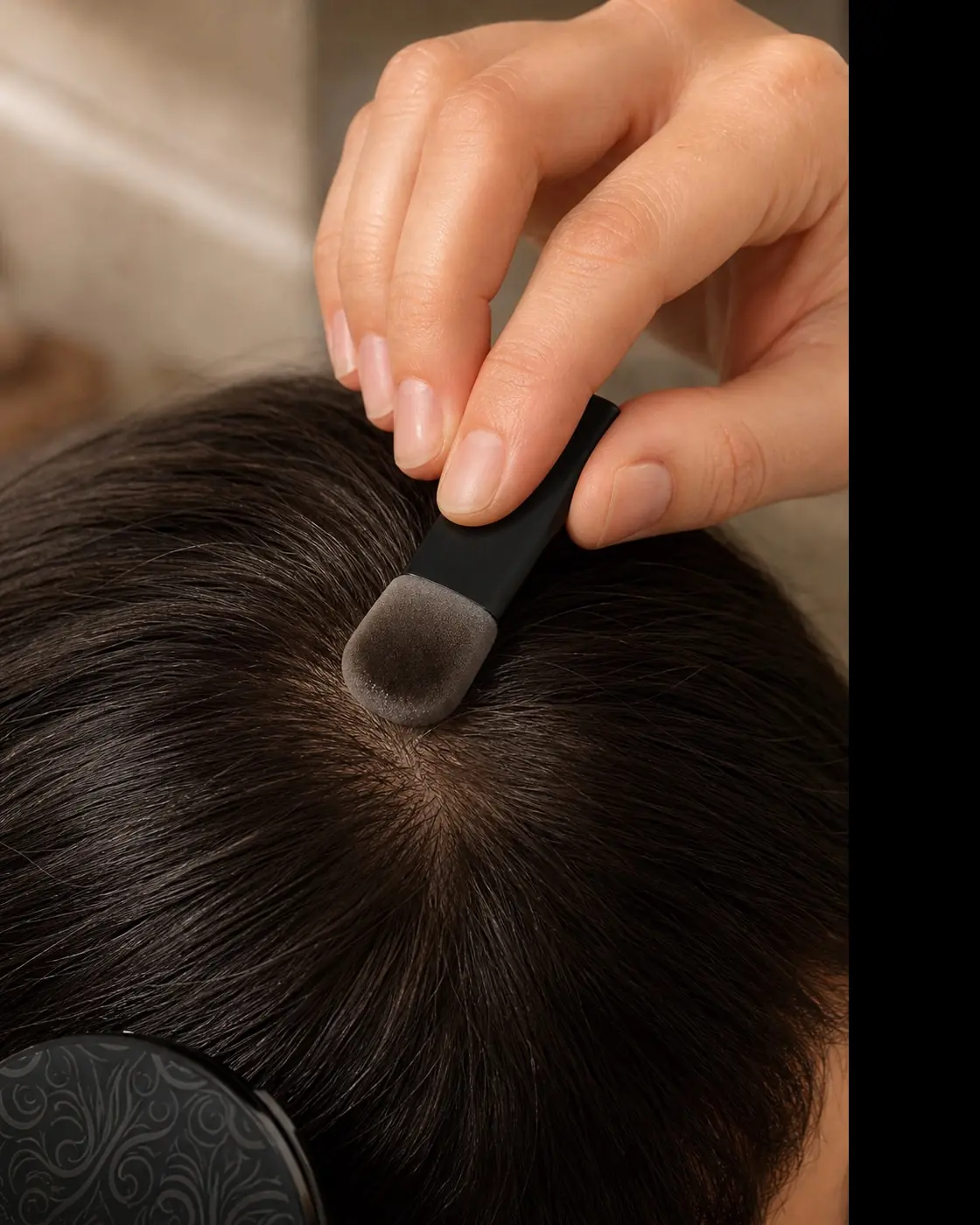
The fix: press the applicator flat against the exposed area and lift straight off. Press, lift, move over, press again. It feels almost too simple, and it’s the single biggest difference between coverage that reads as hair and coverage that reads as makeup.
3. Covering first, styling second
Tension changes everything. Pull your hair into a ponytail after you’ve covered, and the part you so carefully filled in shifts half an inch — taking the coverage with it and exposing skin that was hidden a second ago.
The fix: style first, then cover. Set the part, tie the ponytail, put the clip in, and only then look at what’s actually showing. You’ll use less product and it’ll land where it matters.
4. Applying to damp hair
Powder needs somewhere dry to grip. On a wet or freshly sweaty scalp it clumps instead of setting, and clumping is what makes coverage look patchy.
The fix: dry hair, every time. If you’re coming off a workout or a rainy walk, blot the hairline first and give it a minute. Once it’s on and pressed in, it’s genuinely water resistant — but that’s about staying put afterward, not about going on wet.
5. Checking in only one mirror, under one light
Bathroom lighting is forgiving from the front and brutal from above. A crown can look perfectly filled in head-on and still show a bright stripe from behind — which is the angle everyone else gets.
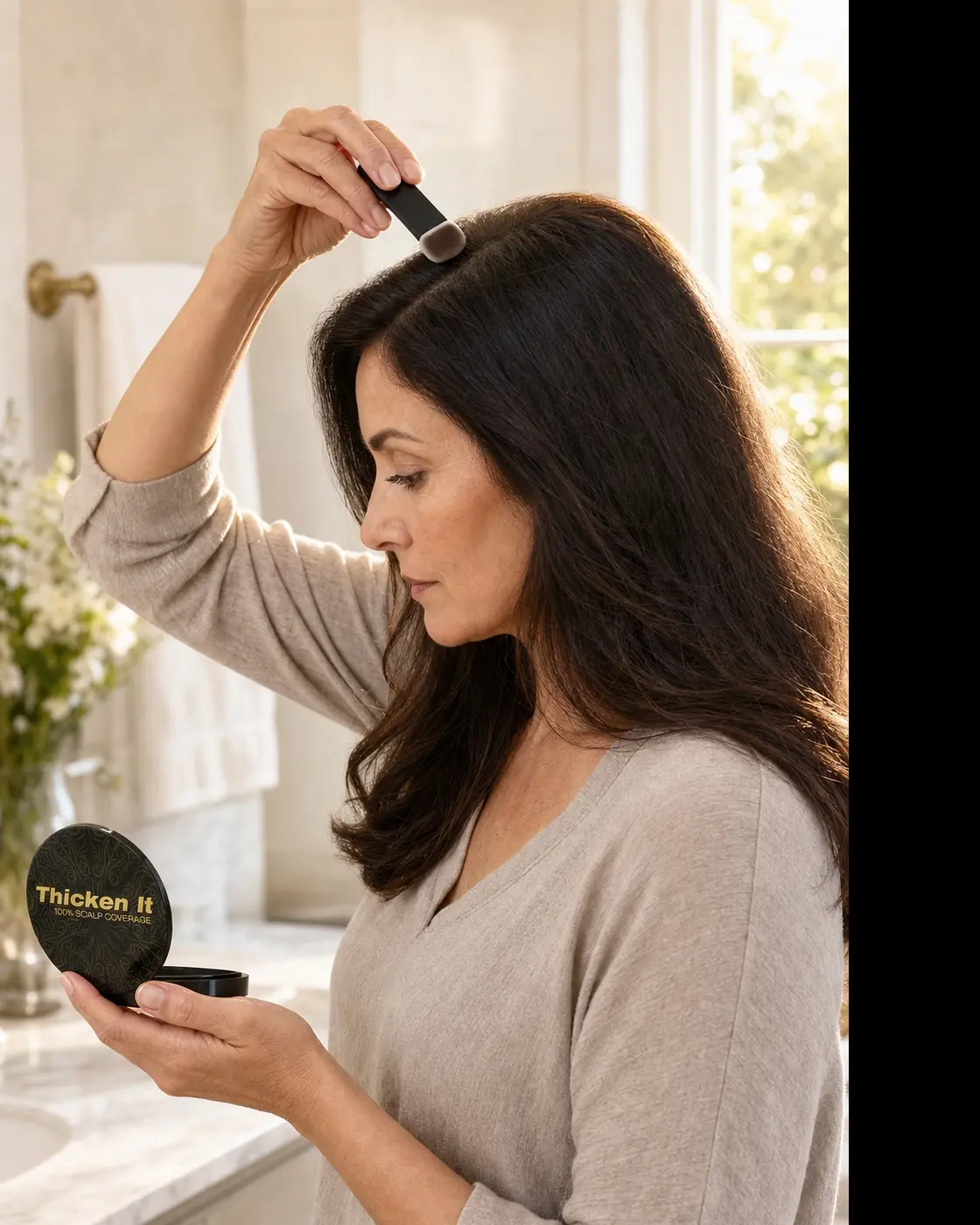
The fix: check the crown with a hand mirror, or take a quick photo with your phone camera flipped around. Then step near a window. Ninety seconds of checking saves the whole “why didn’t anyone tell me” feeling later.
6. Guessing at the shade
Most patchiness that people blame on technique is really a shade mismatch. Too light and it turns dusty against dark hair; too dark and it reads as a shadow rather than density.
The fix: match the hair immediately around the thin area, not your overall color — roots and lengths are often different. Thicken It comes in Dark Brown, Black, Light Brown and Red. When you’re truly between two, take the darker one and apply it lightly; a hair too dark disappears, a hair too light announces itself. There’s a fuller walkthrough in our shade matching guide.
7. Rubbing it afterward
Coverage survives sweat, humidity and rain. What it doesn’t survive is friction — a towel scrubbed back and forth, a headband yanked up over the crown, fingers raking through.
The fix: blot, don’t rub. Slide hats and headbands forward off your face. Treat the covered area the way you’d treat set eye makeup, and it stays where you put it all day. More on that in our water resistance explainer.
Application and results imagery on this page are AI-generated demonstrations of cosmetic coverage. Thicken It covers the appearance of visible scalp and thinning hair; it does not treat, prevent, or regrow hair.
A thirty-second routine that avoids all seven
- Style first. Dry hair, part set, ponytail tied — whatever you’re actually wearing today.
- Press, don’t sweep. Applicator flat on the exposed scalp, lift straight off.
- One light layer. Assess. Add a second only if you need it.
- Smooth the edges with a fingertip so there’s no hard line where coverage stops.
- Check from two angles, one of them from above or behind.
- Hands off. No rubbing, no raking, no checking with your fingers.
That’s it. No mirror gymnastics, no special skill, no learning curve beyond the first couple of mornings.
When coverage isn’t the right question
One thing worth saying plainly: a scalp coverage powder is cosmetic. It changes how thinning looks, from the moment you press it in until the moment you shampoo it out. It isn’t a treatment and it makes no difference to what’s happening at the follicle.
So if your thinning is new, spreading quickly, patchy in an unusual way, or coming with itching, pain or flaking, that’s worth a real appointment rather than a better technique. The American Academy of Dermatology maintains a plain-language overview of what causes hair loss, and a board-certified dermatologist is the right person to sort out which cause applies to you. Cover it in the meantime if you want to — plenty of people do both — but don’t let a cosmetic answer stand in for a medical one.
Give yourself two mornings
Almost nobody nails this on the first try, and almost everybody has it down by the third. Press instead of sweep, use half what you think you need, style before you cover, and check from behind. That’s the whole skill.
Ready to get it right in thirty seconds flat? Shop Thicken It 100% Scalp Coverage Powder →
Related reading: How to Match Scalp Powder Shade to Your Hair · Does Hair Powder Survive Sweat and Swimming? · Hair Fibers vs Hair Powder: Which Scalp Concealer Actually Stays Put? · Widening Part Line? How to Make It Disappear in Seconds · Thinning Crown in Women: Why It Happens and How to Cover It Instantly