
How to Cover Gray Roots Between Salon Visits
Your color looks beautiful for about three weeks. Then a fine silver line starts showing along your part, and every mirror in the house seems to find it. The appointment that would fix it is still two weeks out — so you learn to cover gray roots yourself, or you spend a fortnight parting your hair somewhere it doesn’t want to go.
There’s a better middle. Not a second color service, not a box from the drugstore, and not a hat. Just two minutes at the mirror that carry you from the week the roots appear to the morning you sit down in your colorist’s chair.
The stretch nobody plans for
Salon color doesn’t fade so much as it grows out. Hair grows roughly half an inch a month, so by week three or four there’s a visible band of your natural color — and if that natural color includes gray, the contrast against fresh color makes it read even brighter.
Most women feel that gap the same way: weeks one and two are effortless, weeks three and four are manageable, and weeks five and six are when you start rescheduling your part line every morning. That’s not a coloring failure. It’s just arithmetic.
Stretching appointments is also something a lot of women want to do on purpose — for the cost, for the time, or simply because dermatologists suggest spacing out chemical color services rather than touching up constantly. The trouble has always been what to do about the roots in the meantime.
What it takes to cover gray roots convincingly
The bar here is higher than people expect, because roots sit in the most-examined inch of your whole head. Anything you use has to:
- Match the color you already paid for. Not close. Actually blended, in daylight.
- Cover skin and hair at once. A widening part shows scalp between strands, so covering the gray strands alone leaves the shine underneath.
- Leave no grow-out line. Whatever you use should end where you decide it ends — not create a second demarcation to explain to your colorist.
- Wash out before your appointment. Your stylist needs clean, unaltered hair to work with.
Root sprays and permanent touch-up kits each miss at least one of those. A spray drifts onto your forehead and stiffens the hair it lands on; a box kit adds a chemically colored band that has to grow out on its own schedule.
How Thicken It covers gray roots between appointments
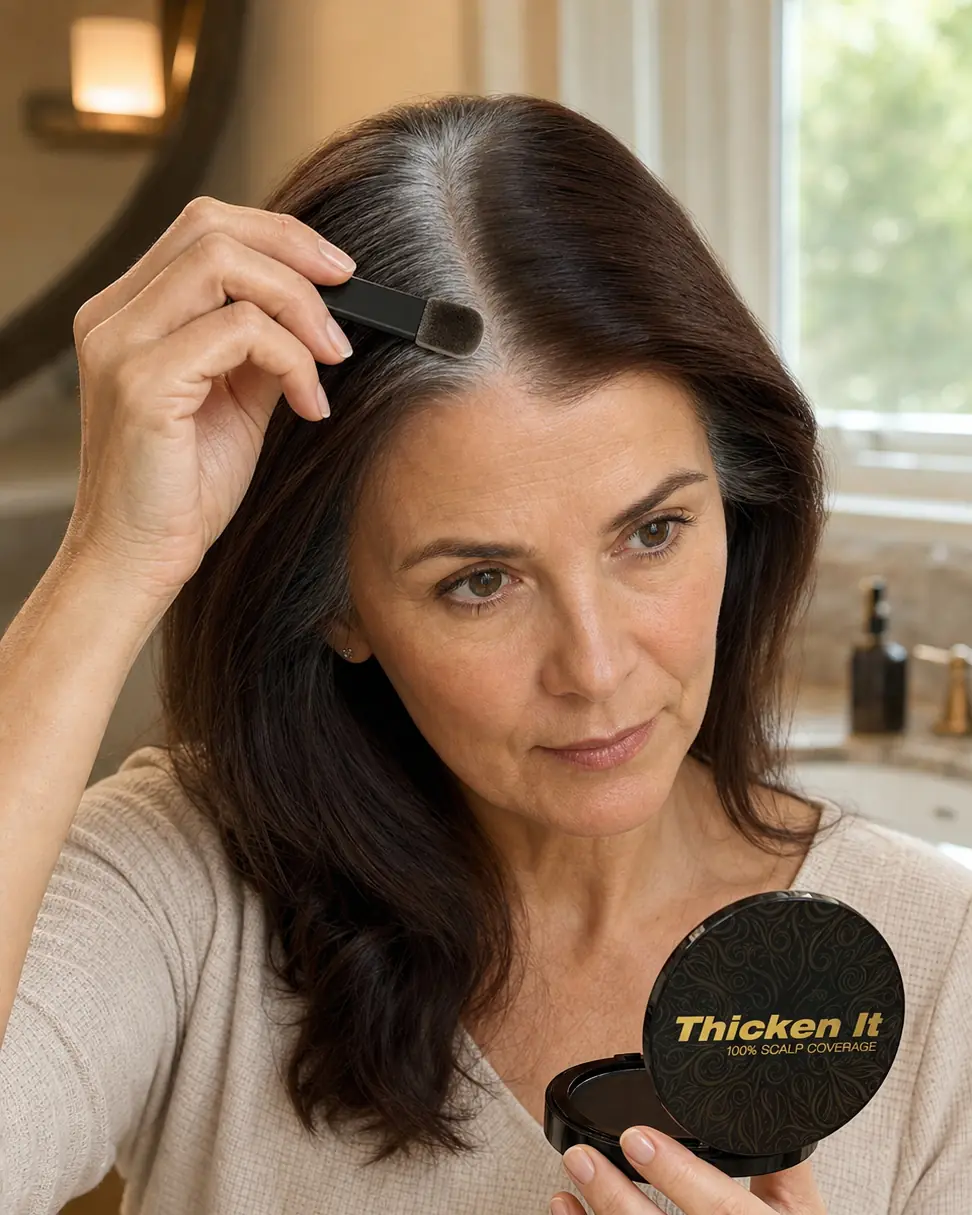
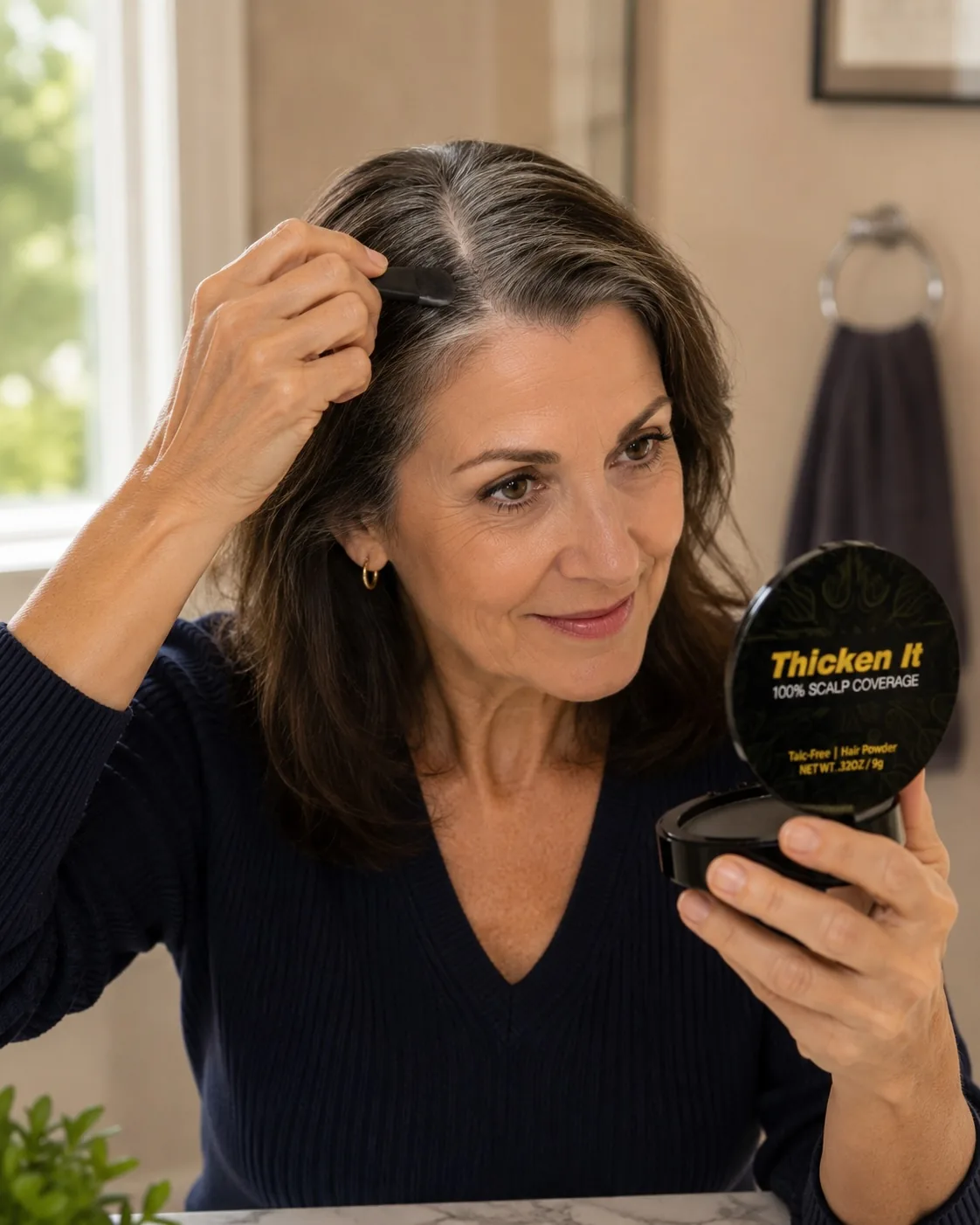
Thicken It is a talc-free coverage powder made from cotton fibers infused with pigment. It doesn’t dye anything. The pigmented fibers cling to the hair shaft and settle onto the scalp beneath, so the gray strands blend into your color and the skin showing through the part stops catching light. The effect is instant, and it lasts until you shampoo it out.
That last part is what makes it work between salon visits rather than competing with them. There’s no processing, no development, no line to grow out — you wash your hair the night before your appointment and your colorist gets exactly the canvas she expects.
Here’s the two-minute routine:
- Start with dry, styled hair. Do this last, after your usual heat or product.
- Open the compact and load the slim paddle applicator with a small amount of powder in your shade.
- Press — don’t swipe — straight down along the part where the gray shows. Pressing sets pigment on both the strands and the scalp beneath them.
- Work outward in short sections, following the line of the part, then feather the ends so nothing stops abruptly.
- Smooth with your fingertips and check in natural light near a window.
(Images shown are AI-generated demonstrations of cosmetic coverage. Thicken It covers the appearance of gray roots and visible scalp; it does not treat, prevent, or regrow hair, and it does not color or lighten your hair.)
Week by week, from fresh color to your next chair
Weeks 1–2. Nothing to do. Enjoy it.
Weeks 3–4. The first grays show at the part and around the temples. A single pass down the part is usually all it takes — thirty seconds, and only where you actually see silver.
Weeks 5–6. The band is wider now, so widen the pass with it. Cover the part first, then the hairline at the temples, which is where most women notice gray next. Keep the pressure light and build in thin layers rather than one heavy application.
Appointment morning. Shampoo it out and arrive with clean hair. Nothing you’ve done in the last six weeks changes what your colorist can do.
Matching your shade
Match the powder to your salon color, not to your natural root. Blending into the color you’re wearing is what makes the covered area disappear.
Dark Brown is the most-reached-for shade and blends into most brunette color. Black suits deep, cool-toned color. Light Brown handles lighter brunettes and darker blondes at the root. Red matches auburn and copper tones. If your color falls between two shades, go with the darker of the two and apply less — light layers of a slightly deeper shade read more natural than heavy layers of a shade that’s too light.
Frequently asked questions
Will it interfere with my next color service?
No. It sits on the surface and shampoos out completely, so it doesn’t change how color takes.
Does it come off on my pillow or my hands?
Pressed in and smoothed, it holds through a normal day and a night’s sleep. It’s water resistant, not waterproof — heavy rubbing on the same spot can transfer a little.
Can I use it on my hairline and temples too?
Yes, and most women do. The temples gray early and sit right at eye level.
Is it safe to use every day between appointments?
It’s a cosmetic powder that washes out with shampoo, so daily use is a styling choice, not a commitment.
Will it slow down the gray?
No. Graying is a normal follicle change, and nothing applied to the surface of the hair affects it. This covers the appearance, nothing more.
Buy yourself the extra two weeks
Stretching a color appointment shouldn’t mean living with a silver stripe for the last fortnight. Two minutes at the mirror keeps your part looking finished, and the calendar goes back to being your decision instead of your roots’.
Ready to stretch your next appointment? Shop Thicken It 100% Scalp Coverage Powder →
Related reading: Root Touch-Up at Home: Between-Salon Coverage for Women · Gray Hair Coverage Without the Dye: How Scalp Powder Works · Widening Part Line? How to Make It Disappear in Seconds · The Purse Touch-Up Kit That Goes Everywhere You Do