
Talc Free Hair Powder: What It Means and Why It Matters for Scalp Products
“Talc-free” shows up on so many labels now that it has started to feel like background noise — the beauty-aisle equivalent of “new and improved.” But if you’re pressing something onto your scalp and into your hair every single morning, it’s worth ninety seconds of your attention. A talc free hair powder isn’t a marketing badge. It’s a formulation decision, and it changes how the product feels, how it grips, and how long your coverage lasts.
Here’s the plain-English version, without the scare tactics.
What a talc free hair powder actually is
Talc is a soft mineral — magnesium silicate — mined from the earth and ground into one of the silkiest powders in existence. Cosmetic chemists have loved it for a century because it does three things beautifully: it absorbs oil, it slips across skin, and it keeps a pressed powder from caking. You’ll find it in pressed face powders, blushes, body powders, and plenty of dry shampoos.
A talc-free formula simply means the manufacturer built the product on something else. What that “something else” is matters enormously, because the replacement ingredient is doing all the actual work.
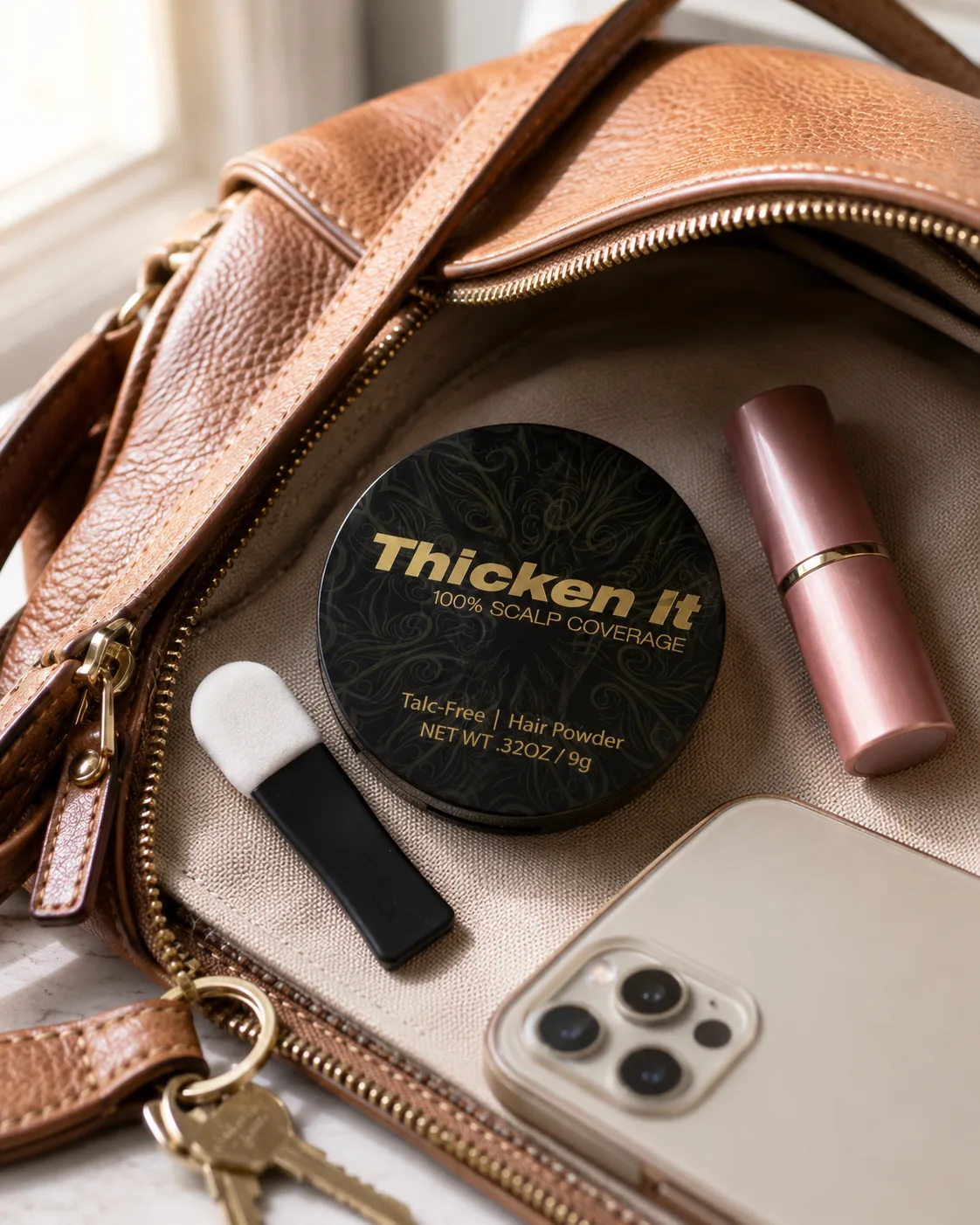
In Thicken It’s case, the base is pressed cotton fibers carrying pigment. Not a mineral slip agent — an actual fiber. That distinction is the whole story, and we’ll get to why in a moment.
Why the talc conversation started in the first place
Let’s be accurate here, because there’s a lot of alarmist writing on this subject and none of it helps you make a decision.
Talc and asbestos can occur near each other in the ground, which means talc intended for cosmetics has to be sourced and purified carefully. That’s a real supply-chain concern, and it’s why regulators pay attention. Under the Modernization of Cosmetics Regulation Act, the FDA has proposed requiring standardized testing methods for asbestos in talc-containing cosmetics — you can read the agency’s own plain summary on the FDA’s talc information page.
And the honest headline from that same agency: in the FDA’s 2022 and 2023 sampling programs, asbestos was not detected in any of the products tested. So no, cosmetic talc is not something to lie awake over.
What that leaves is a preference — and preferences are allowed. Plenty of women simply decide they’d rather not put a mined mineral on their scalp every day when a fiber-based alternative exists. That’s a perfectly good reason, and it doesn’t require anyone to be frightened into it.
But there’s a second reason to care, and for scalp coverage specifically, it’s the more interesting one.
On a scalp, talc and fiber behave very differently
This is where the ingredient swap stops being philosophical and starts being practical.
Talc’s signature quality is slip. It glides, it feels weightless, it absorbs oil — which is exactly what you want on a T-zone and exactly the wrong instinct at your part line. A powder built to slide is a powder that migrates: onto your forehead, down your temples, onto a pillowcase, onto the collar of a white blouse.
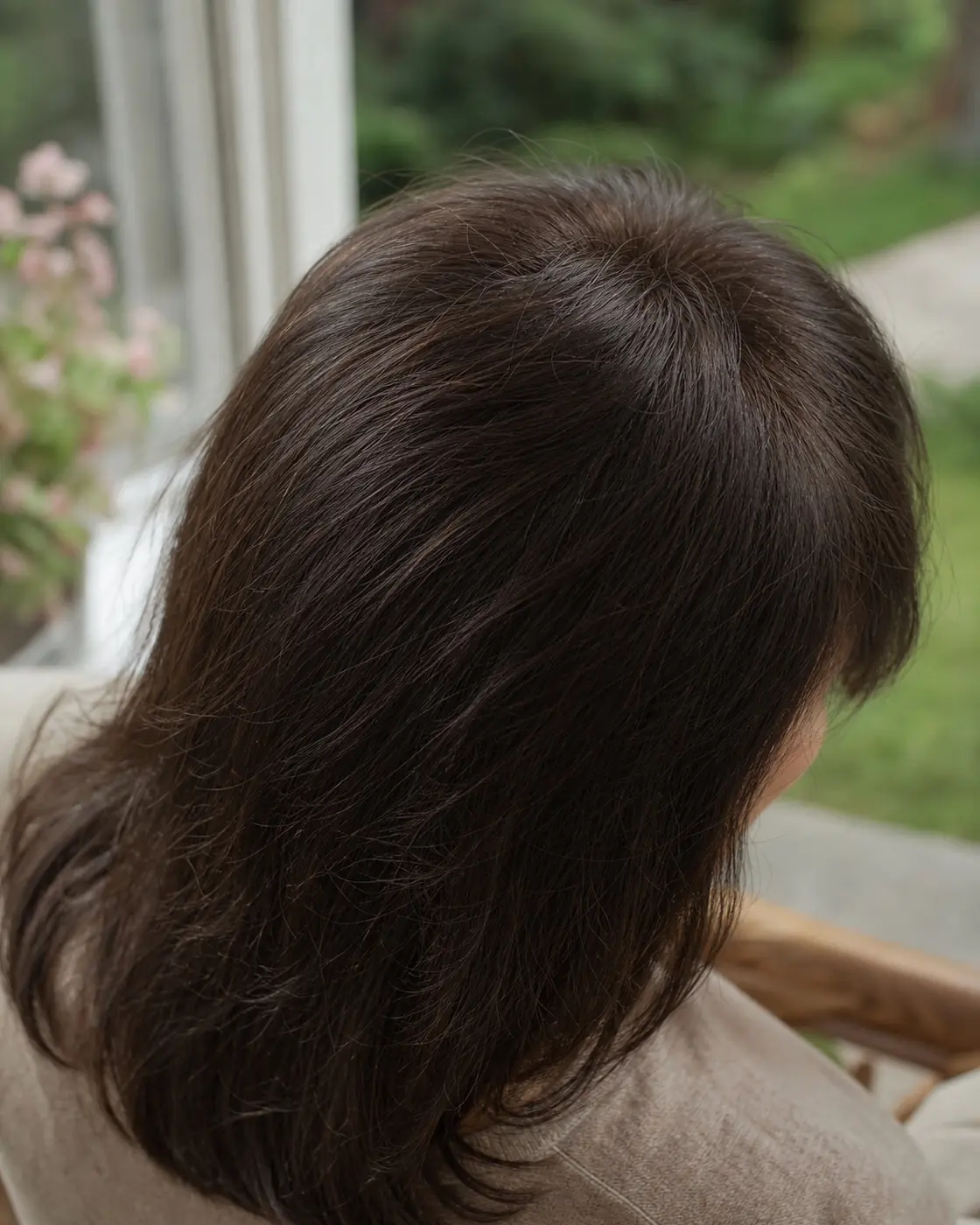
Pressed cotton fiber does the opposite. Fibers have texture and grip. When you press pigmented cotton fiber onto the scalp and the hair around a thin spot, it grabs the strand and stays where the applicator put it. That’s what makes coverage survive a windy parking lot, a humid afternoon, or a hand run absent-mindedly through your hair.
It’s also what makes Thicken It water resistant once it’s pressed in and smoothed — it holds through sweat, humidity, and rain, and washes out cleanly with shampoo and a good lather. (Water resistant, not waterproof. Vigorous towel-scrubbing on one spot will lift some of it; blot instead, and touch up in ten seconds if you need to.)
There’s a visual difference, too. A slip-based powder tends to sit as a flat film that can read chalky or gray in daylight. Fiber sits with a bit of dimension, so the covered area picks up light the way the hair around it does. That’s the difference between “the scalp is hidden” and “the hair looks fuller” — and only the second one goes unnoticed.
(Product and results imagery on this page are AI-generated demonstrations of cosmetic coverage. Thicken It covers the appearance of visible scalp and thinning hair; it does not treat, prevent, or regrow hair.)
How to read a scalp powder label in thirty seconds
You don’t need a chemistry degree. You need four habits.
Look at the first ingredient, not the front of the box. Ingredients are listed in descending order by weight. Whatever sits at the top is what you’re mostly buying. “Talc-free” on the front means nothing if you don’t know what took its place.
Find out whether the base is a mineral or a fiber. Minerals slip. Fibers grip. On a scalp, in wind, that difference is the entire product.
Check what it takes to remove it. A cosmetic that comes out with ordinary shampoo is one you can wear daily without ceremony. Anything requiring a special remover is a commitment, not a convenience.
Be skeptical of any hair product promising growth. A cosmetic powder covers the appearance of thinning. It does not treat, prevent, or regrow anything, and neither does any concealer in this category. If your hair loss is sudden, patchy, or worsening quickly, that’s a conversation for a dermatologist — and there is no reason you can’t have both: professional answers about the cause, and coverage that lets you feel like yourself while you get them.
Frequently asked questions
Is talc free hair powder better for sensitive scalps?
People with easily irritated skin often prefer simpler, fiber-based formulas, and Thicken It is talc-free and built on pressed cotton fiber. That said, we don’t make skin-health claims — always read the full ingredient list on the pack, and if you have a diagnosed scalp condition, ask your dermatologist before adding any new product.
Does going talc-free mean it works less well?
The opposite, in our experience. Slip is a liability at the hairline. Grip is what keeps coverage in place all day.
Will it wash out?
Yes — shampoo and lather, and it’s gone. Nothing builds up, and nothing interferes with your next color appointment.
Which shade should I choose?
Thicken It comes in Dark Brown, Black, Light Brown, and Red. Match the hair immediately around the thin spot. If you’re between two shades, take the darker one and apply lightly — you can always build.
Is it safe to use every day?
It’s a cosmetic that washes out with shampoo, so daily wear is a styling choice, like any other makeup you’d reach for in the morning.
A small decision, made once
You already read labels on the things you put on your face. Your scalp deserves the same thirty seconds — and then it deserves to be forgotten about, because the right formula is the one you stop thinking about entirely.
Ready for talc-free coverage that stays where you press it? Shop Thicken It 100% Scalp Coverage Powder →
Related reading: Hair Fibers vs Hair Powder: Which Scalp Concealer Actually Stays Put? · Water Resistant Hair Powder: Does It Survive Sweat and Swimming? · The Purse Touch-Up Kit That Goes Everywhere You Do · How to Cover Gray Roots Between Salon Visits