
How to Match Scalp Powder Shade to Your Hair: A Simple Color Guide
Choosing a color online feels like a gamble. You’re looking at four little swatches on a screen, trying to picture them against hair you can’t quite describe, and the stakes feel higher than they should. Here’s the reassuring part: to match scalp powder shade to your hair, you don’t need a perfect color read. You need a close one — because a fiber powder that fills in the space between strands is judged by shadow, not by pigment.
That single fact makes this much easier than matching foundation or box dye. Let’s walk through it.
Why matching powder isn’t like matching hair dye
Dye coats the strand. If the color is off by half a level, every hair on your head announces it, in daylight, for six weeks.
Scalp coverage powder does something else entirely. It settles onto the scalp and clings to the hair immediately around a thin area, darkening the pale gap that’s showing through. What your eye registers afterward isn’t “that’s the wrong brown” — it’s simply density. The bright scalp stops flashing, the hair reads fuller, and the exact pigment matters far less than you’d expect.
Which means the goal isn’t a laboratory match. The goal is close enough that no gap of light gives you away.
How to match scalp powder shade in about a minute
Four steps, done in front of a window rather than a bathroom bulb.
1. Match the hair, not the roots. Look at the hair immediately surrounding the spot you want to cover — the mid-lengths where they meet the scalp, not the ends. Ends are usually lighter from sun and styling, and they’ll pull you a shade too pale.
2. Check it in daylight. Warm indoor bulbs make everything look more golden than it is; fluorescent light does the opposite. Step to a window with a small mirror before you decide.
3. When you’re between two shades, take the darker one. This is the rule that saves people. Powder is buildable — you can press on a whisper of a darker shade and stop. You cannot make a too-light powder darker, and a too-light powder is the one that reads chalky and gets noticed.
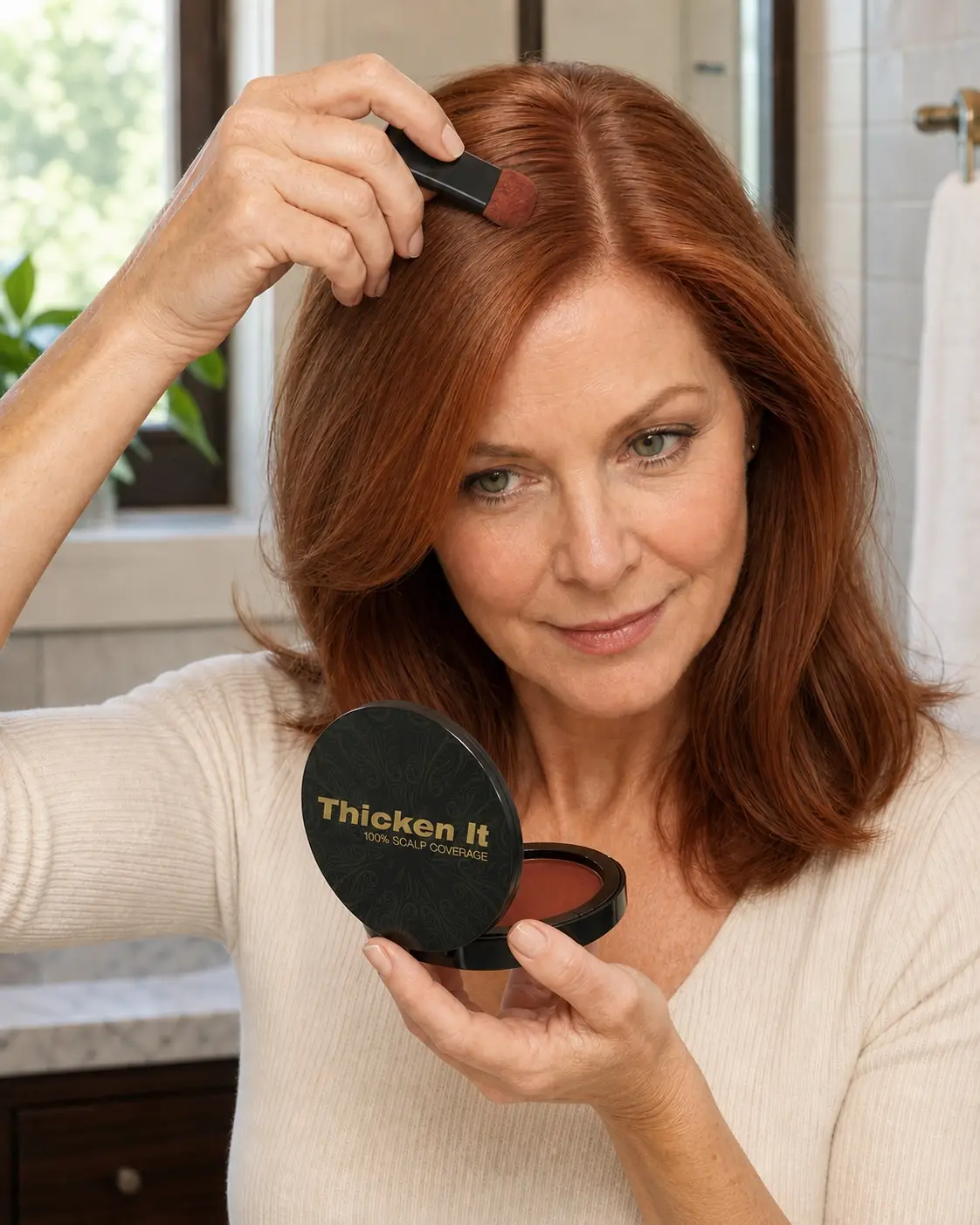
4. Apply lightly the first time. Load the slim foam applicator, tap off the excess, press (don’t sweep) onto the thin area, then smooth with your fingertips. Look again. Add more only if the scalp still shows.
(Application and results imagery on this page are AI-generated demonstrations of cosmetic coverage. Thicken It covers the appearance of visible scalp and thinning hair; it does not treat, prevent, or regrow hair, and it does not permanently color or dye your hair.)
Understanding your undertone
Most people describe their hair with one word — brown, black, red — but hair is rarely one thing. Color comes from two pigments: eumelanin, which produces black and brown tones, and pheomelanin, which produces red and warm ones, as explained by MedlinePlus Genetics. Nearly everyone carries some of both, in a ratio that’s individual to them.
That’s why a “cool” brown and a “warm” brown can be the same depth and still look wrong beside each other. So after you decide how dark your hair is, ask one more question: does it lean warm — copper, auburn, golden — or neutral and ashy?
If you see obvious warmth, especially at the temples or in sunlight, warmth is what you should match.
The four shades, and who each one is for
Dark Brown — our most popular shade and the safe default for medium to deep brown hair. It’s also the shade most people land on when they’re honestly between two.
Black — for true black and very dark brown-black hair. If your hair looks black indoors but shows brown in sunlight, Dark Brown usually blends more softly.
Light Brown — for lighter brown and light-to-mid brunette hair, and for anyone whose color has softened with age. Use a light hand here; light shades are the ones most likely to look powdery if overloaded.
Red — for auburn, copper, and red-toned hair, including salon reds that have faded warm. If you’ve ever tried covering a part line with a neutral brown and thought it looked flat and slightly gray, this is why.
What if you’re mostly gray?
Gray hair is where instincts tend to go wrong, so let’s be clear about what you’re actually deciding.
If you color your hair and you’re covering grow-out, match the color you wear, not the gray underneath. Press the powder along the part line where the new growth shows and blend outward — the grays disappear into the surrounding color and your appointment calendar stops running your life.
If you’ve grown your gray out and love it, you’re not trying to hide the gray at all. You’re trying to hide the scalp showing through it. Many women in that position find a lighter shade used very sparingly does the job, because you only need to knock down the brightness of the skin, not add color to the hair.
And if you’re growing gray out on purpose, powder is genuinely useful during the awkward months — it covers the appearance of the demarcation line without any commitment, and shampoos out completely.
Matching a beard, mustache, or brows
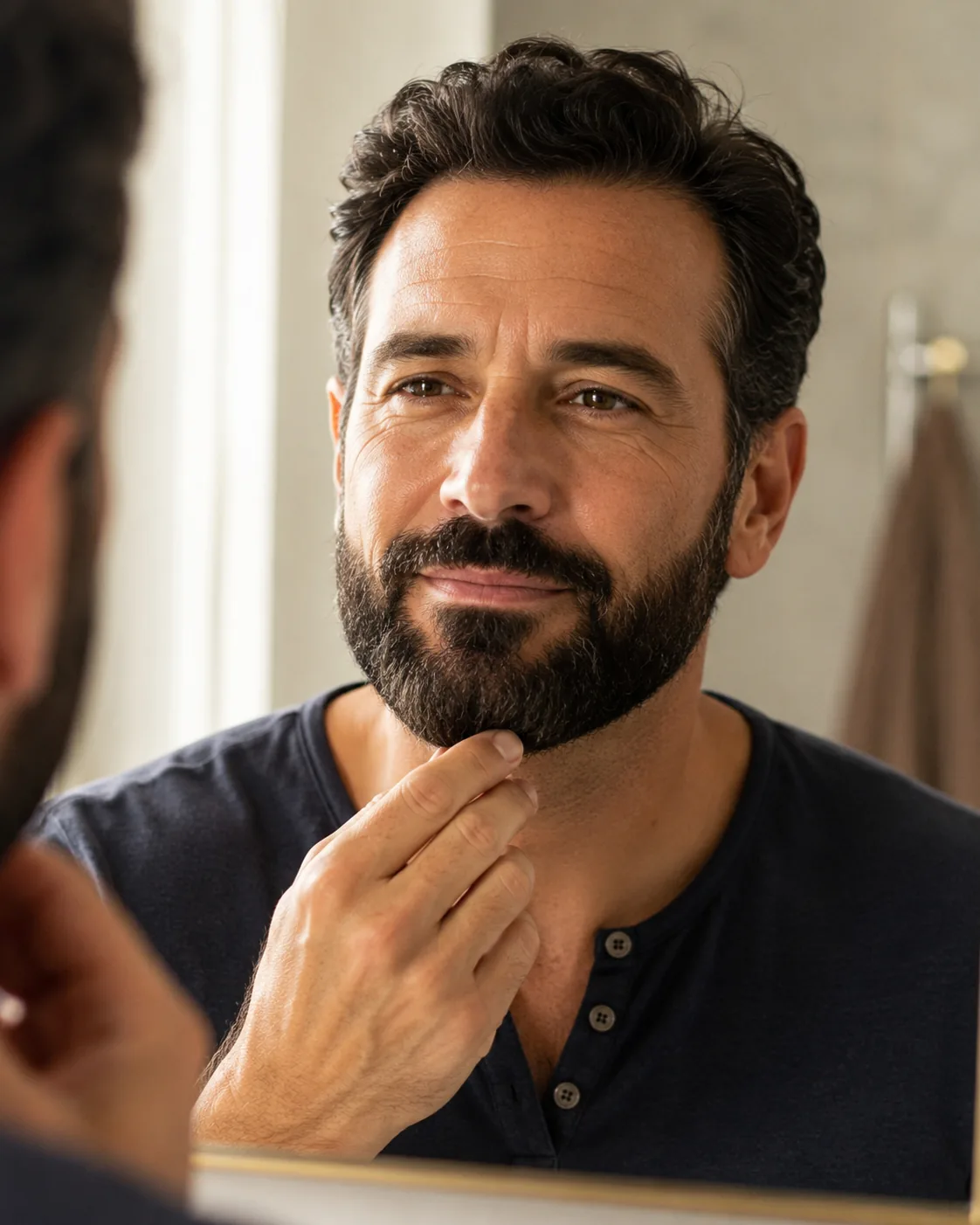
Facial hair is often a full shade warmer or lighter than the hair on your head, so match it separately rather than assuming.
For beards and mustaches, match the darkest area — usually the mustache and the hair closest to the mouth — and let the powder blend outward into the grays at the chin and sideburns. For brows, match the brow hair itself and go lighter than you think: brows are a small area and a heavy hand reads instantly.
Frequently asked questions
What if I choose wrong?
Apply it very lightly and look in daylight before you decide it’s wrong. A shade that felt too dark straight out of the compact is often perfect at half the amount. And because it shampoos out completely, a bad five minutes is a bad five minutes — nothing is permanent.
Can I mix two shades?
Yes. Multi-tonal, highlighted, or balayage hair often looks best with a darker shade at the roots and a lighter one feathered where the highlights start.
Will it change my hair color?
No. It’s a cosmetic that sits on the surface and washes out with shampoo and a good lather. It doesn’t dye, lighten, or alter your hair in any way, and it won’t interfere with your next color service.
Does the shade affect how long it lasts?
No — all shades are the same pressed cotton fiber formula, and all are water resistant once pressed in and smoothed. (Resistant, not waterproof: blot rather than rub, and touch up in seconds if you need to.)
Trust the close match
Pick the shade that matches the hair around the thin spot, go darker when you’re torn, and apply less than you think you need. That’s the whole method — and once you’ve done it once, you’ll never think about it again.
Ready to find yours? Shop Thicken It 100% Scalp Coverage Powder →
Related reading: Talc Free Hair Powder: What It Means and Why It Matters · How to Cover Gray Roots Between Salon Visits · Gray Mustache Coverage and Sideburns: Small Fixes, Big Confidence · Hair Fibers vs Hair Powder: Which Scalp Concealer Actually Stays Put? · Filling In Sparse or Graying Eyebrows with Hair Powder