
Scalp Powder vs Dry Shampoo: What Each One Actually Does
They live on the same shelf, they both come out of a container and go onto your roots, and they both get reached for on a morning when your hair isn’t cooperating. So the scalp powder vs dry shampoo question comes up constantly — and the answer is simpler than the shelf makes it look. One is dealing with oil. The other is dealing with light.
Get that distinction straight and you’ll stop asking which one to buy, because you’ll know exactly which problem you’re solving.
The scalp powder vs dry shampoo difference in one sentence
Dry shampoo absorbs oil so your hair looks freshly washed. Scalp coverage powder dims the contrast between your hair and the skin underneath so your scalp stops showing through.
That’s it. Different jobs, different results, and — this is the part most people miss — they don’t compete. You can have perfectly clean, voluminous hair and still see a bright line of scalp down your part. Dry shampoo won’t touch that. And you can have beautifully covered roots that are also two days dirty. Powder won’t touch that.
(Application and results imagery on this page are AI-generated demonstrations of cosmetic coverage. Thicken It covers the appearance of visible scalp and thinning hair; it does not treat, prevent, or regrow hair.)
What dry shampoo actually does
Dry shampoo is an absorbent — usually a starch, clay or alcohol-based spray. It soaks up the sebum sitting at your roots, which does two things at once: it takes away the greasy, separated look, and it adds a little grit that makes fine hair stand up instead of lying flat.
Where it genuinely shines:
- Stretching the time between washes. The original job, and it’s good at it.
- Adding lift and texture at the roots on fine or limp hair.
- Emergency freshening — after a workout, before an unplanned dinner.
Where it runs out of road: dry shampoo has no opinion about the color of your scalp. Lifting the roots can even make things worse if thinning is your concern, because separating hair at the part opens the gap rather than closing it. Plenty of women have sprayed more dry shampoo at a widening part, gotten more volume, and still seen the same stripe of skin in the mirror.
What a scalp coverage powder actually does
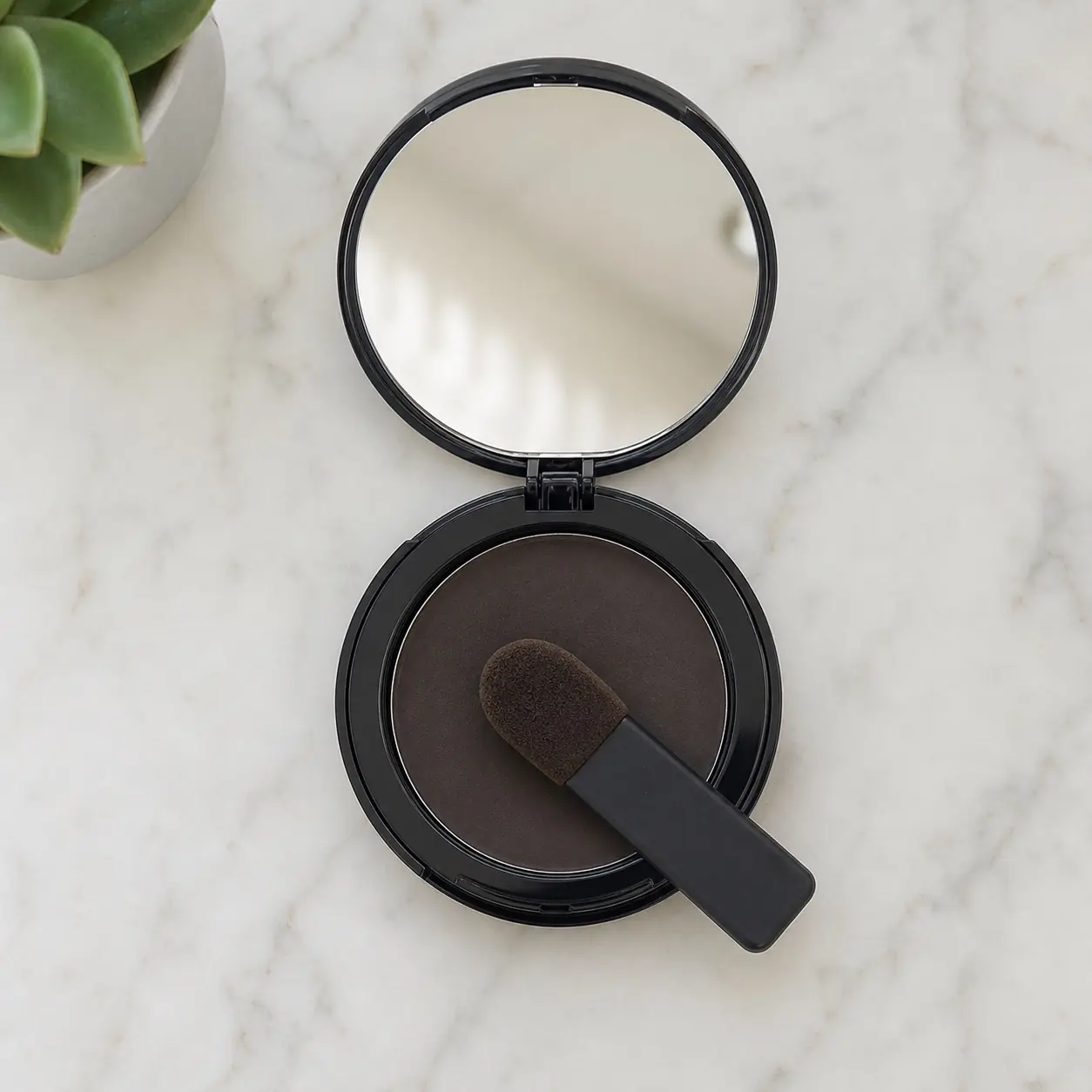
A scalp coverage powder isn’t absorbing anything. It’s a pressed, tinted cotton fiber that you press — never sweep — directly onto the skin showing between strands. When the bright scalp goes closer in tone to the hair around it, the contrast drops. Your eye stops snagging on it, and the area reads as denser.
Nothing has been added to your hair. Nothing has changed about your hair. What’s changed is how light bounces off the space between the hairs, and that turns out to be nearly all of what makes thinning look like thinning.
Where it shines:
- A part line or crown that’s getting wider.
- Gray roots between color appointments — it covers the appearance without dyeing anything.
- Temples, hairlines, and the back of the crown you can only see in a second mirror.
- Photos and overhead lighting, where scalp shows most.
Side by side
| Dry shampoo | Scalp coverage powder | |
|---|---|---|
| Main job | Absorbs oil | Covers visible scalp |
| Works on | The hair | The skin between the hair |
| Result | Cleaner look, more lift | Less contrast, denser look |
| Color-matched? | Usually not (or only roughly) | Yes — Dark Brown, Black, Light Brown, Red |
| Removal | Next wash | Next wash |
| Best on | Day-two-or-three hair | Any hair, clean or not, as long as it’s dry |
The tinted dry shampoo confusion
This is where the categories blur, and it’s worth being straightforward about it. Tinted dry shampoos exist, and for a light dusting of gray at the temples they can take the edge off.
But they were built as absorbents first and colorants second, so the pigment is usually loose, sprayed rather than placed, and lands on hair as much as on scalp. That means it can transfer, and it rarely gives you the precise, edge-to-edge placement that a widening part needs. It’s a blur, not a fill.
A coverage powder inverts those priorities. The pigment sits in a pressed cake, you place it deliberately with a small paddle, and it goes exactly where you press it. If your concern is genuinely visible scalp rather than slightly dull roots, that precision is the whole difference. There’s more on how the formats behave in our hair fibers vs hair powder comparison.
Using both — and the order that matters
Most people who use both end up in the same routine, because doing it backwards wastes product:
- Dry shampoo first. Spray at the roots, wait the thirty seconds the can asks for, and work it in. Let it finish absorbing.
- Style second. Set your part, tie the ponytail, put the clip in. Tension moves coverage, so you want the shape settled before you fill anything in.
- Powder last. Press it onto whatever scalp is still showing after steps one and two — which is usually less than you expected.
Two reasons for that order. Powder needs a dry, settled surface to grip, and a wet aerosol landing on top of placed coverage will move it. And because dry shampoo adds a little lift, some of the scalp you saw at the start is already hidden by the time you get to step three, so you use noticeably less powder.
One honest caveat about durability: once pressed in, Thicken It is water resistant — it holds through sweat, humidity and rain — but resistant is not waterproof. Friction is what lifts it, so blot instead of rubbing, slide headbands forward rather than yanking them up, and know that shampoo takes it out completely. The full picture is in our water resistance explainer.
What neither product does
Worth saying plainly, since the shelf tends to imply otherwise: neither a dry shampoo nor a scalp coverage powder treats hair loss. Both are cosmetic. Thicken It changes how thinning looks, from the moment you press it in until the moment you wash it out, and it has no effect on what’s happening at the follicle in either direction.
So if your thinning is new, spreading quickly, patchy in an unusual way, or arriving with itching, burning or flaking, that deserves an actual appointment rather than a different product. The American Academy of Dermatology keeps a plain-language guide to the difference between hair loss and hair shedding, and a board-certified dermatologist is the right person to work out which one you’re dealing with. Cover it in the meantime if you’d like to — most people do both.
So which one do you need?
Ask yourself what you actually see in the mirror. Greasy, flat, separated roots on day three? Dry shampoo. A stripe of scalp at the part, a bright patch at the crown, gray showing at the temples three weeks after your color? That’s a coverage job, and no amount of oil absorption will do it.
And if the honest answer is “both, most mornings” — that’s normal, and the routine above takes about ninety seconds start to finish.
Ready to cover what dry shampoo can’t? Shop Thicken It 100% Scalp Coverage Powder →
Related reading: Scalp Powder Application Mistakes (and the Easy Fixes) · How to Match Scalp Powder Shade to Your Hair · How to Cover Gray Roots Between Salon Visits · Scalp Powder, Sweat, and Workout Days · Widening Part Line? How to Make It Disappear in Seconds